

Confined Space Rescue Requirements in 2026: What Changed and What Didn’t
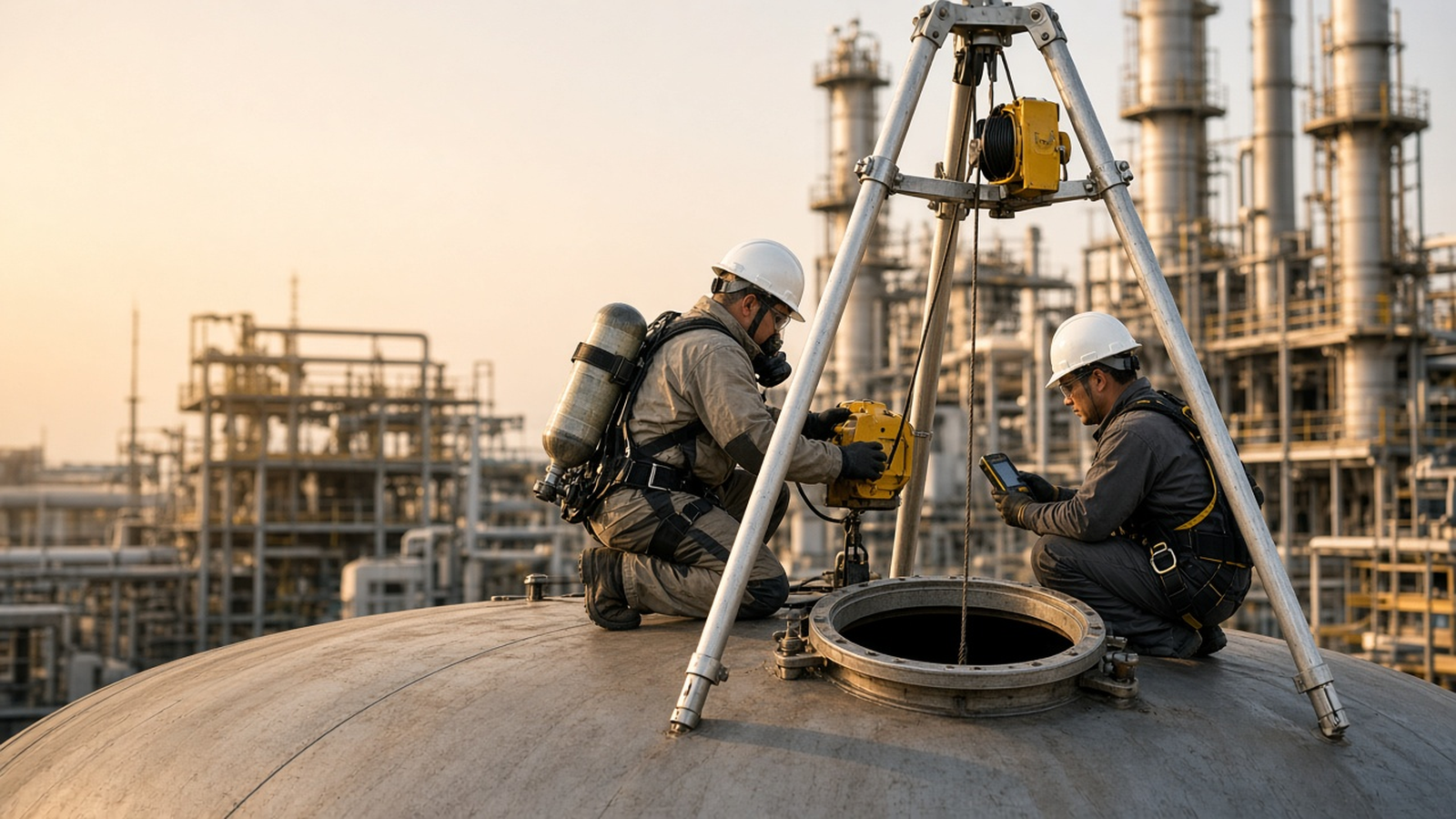
If you run turnarounds, outages, or tank and vault work, a few things changed this year on the rescue side. NFPA issued new editions of the two standards most rescue teams train to, and OSHA's long-running Emergency Response rule now has a target date for the final version. The OSHA and Cal/OSHA confined space rules themselves haven't changed.
Here's where things stand, and what to check before the next permit gets signed.
What's New in 2026
NFPA 1006, 2027 Edition (Rescue Technician Qualifications)
NFPA 1006 sets the job performance requirements for individual technical rescue personnel, including confined space rescue technicians. The 2027 edition was issued April 16, 2026 and took effect May 6, 2026. (NFPA 1006).
NFPA 2500, 2027 Edition (Organizational Capability, Rope and Equipment)
NFPA 2500 combines three standards rescue teams have known for years: NFPA 1670 (technical search and rescue operations), NFPA 1858 (care and maintenance of life safety rope and equipment), and NFPA 1983 (life safety rope and equipment). The 2027 edition was issued and took effect on the same dates as NFPA 1006. (NFPA 2500).
The committee made the split clear during this revision: NFPA 2500 covers the organization, and NFPA 1006 covers the individual rescuer (NFPA First Revisions, NFPA 2500).
What this means when you hire a rescue service: ask for rescuer qualifications to NFPA 1006, team capability to NFPA 2500, and rope and hardware that meet the former NFPA 1983 chapters. OSHA doesn't require NFPA certification, but it does require you to evaluate the team's proficiency, and NFPA is the usual yardstick.
OSHA Emergency Response Rule: Final Rule Targeted for April 2027
Proposed in February 2024, this rule would replace the 1980 Fire Brigades standard (29 CFR 1910.156) and, for the first time, cover workers who provide technical search and rescue and EMS. OSHA's 2026 regulatory agenda lists the final rule for April 2027 (Reginfo.gov, RIN 1218-AC91; OSHA). If your facility runs its own rescue team or plant fire brigade, watch this one.
What Hasn't Changed: The OSHA and Cal/OSHA Rescue Rules
Quick Reference: Who Requires What
Federal, general industry: 29 CFR 1910.146(k)
Federal, construction: 29 CFR 1926.1211 (Subpart AA)
California, general industry: Title 8, §5157(k)
California, construction: Title 8, Article 37, §1960
Rescue team practice: at least once every 12 months, in the actual space or a representative one
First aid/CPR: at least one rescue team member with current certification available
Retrieval: harness and retrieval line on every entrant unless it adds risk; a mechanical device for vertical spaces deeper than 5 feet
Under federal OSHA, an employer that designates a rescue service has to evaluate whether the team can respond in a timely manner for the hazards identified, confirm the team is equipped and proficient for those spaces, tell the team about the hazards, and give it access to the spaces so it can plan and practice (1910.146(k)(1)).
The construction rule adds two items. The rescue service has to agree to notify you immediately if it becomes unavailable, and if you don't choose non-entry rescue, you have to designate an entry rescue service (1926.1211).
California is stricter on paper. Section 5157(k) says the employer "shall ensure that at least one standby person at the site is trained and immediately available to perform rescue and emergency services" (Cal/OSHA §5157). If you work in California, read that line twice before you write a rescue plan that depends on an off-site team.
Response Time: Why "Call 911" Isn't a Rescue Plan
OSHA doesn't publish one response time for every job. Appendix F to 1910.146 gives the guidance most safety managers use:
For entry into an IDLH atmosphere, or a space that can quickly become IDLH if ventilation fails, the rescue team "would need to be standing by at the permit space."
If the only hazards are mechanical, like broken bones or abrasions, "a response time of 10 or 15 minutes might be adequate."
“Merely posting the service’s number or planning to rely on the 911 emergency phone number to obtain these services at the time of a permit space emergency would not comply.”
Attendant vs. Rescue Team
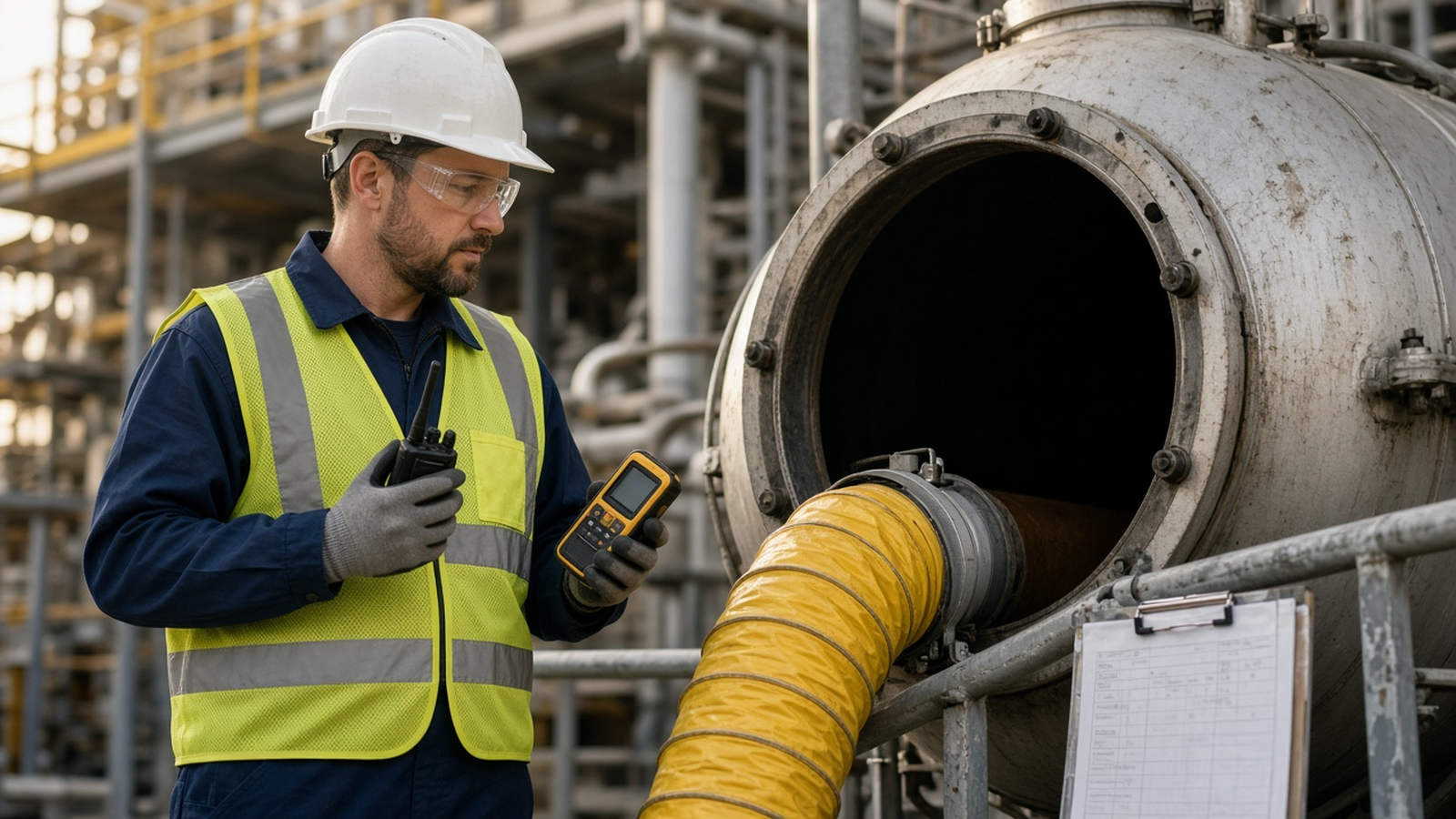
We still see programs where the attendant is the rescue plan. OSHA treats these as two jobs.
The attendant (1910.146(i)):
Stays outside the space for the whole entry until relieved
Keeps a count of who is inside and orders evacuation when conditions change
Summons rescue as soon as entrants may need help
Can run non-entry rescue, such as cranking a retrieval winch
Does nothing that pulls attention away from the entrants
An attendant can go in only if the program allows it, they're trained and equipped as a rescuer, and another attendant has taken over first.
The rescue team makes the entry: SCBA or supplied air, patient assessment, packaging, and removal. Appendix F asks whether the team can get a patient out through a portal 24 inches or less, run a high-angle rescue, and test the atmosphere for IDLH conditions (Appendix F). We compared in-house and contracted teams in an earlier post on in-house vs. third-party confined space rescue teams.
A California Refinery Case
On November 12, 2021, a 35-year-old contract worker went into a regenerator overflow well at the Valero refinery in Benicia ahead of a welding crew. A welding torch left in the well was leaking argon, which displaced the oxygen. The refinery's rescue team retrieved him, but he couldn't be revived. Cal/OSHA cited Valero and three contractors a combined $1,753,375, including willful violations for failing to determine acceptable entry conditions (Cal/OSHA news release 2022-42). We wrote more about the atmospheric side in Atmospheric Hazards within a Confined Space.
The rescue team was there. The entry conditions weren't checked. Standby rescue works best when it's part of a permit program that's actually followed.
Why This Still Matters
The BLS counted 1,030 deaths involving confined spaces from 2011 to 2018. Texas (106) and California (65) had the most (BLS; BLS by state).
NIOSH reported that more than 60% of confined space fatalities in the incidents it reviewed were would-be rescuers (NIOSH 86-110). A later NIOSH study put it near 25% (NIOSH).
Where Standby Rescue Fits
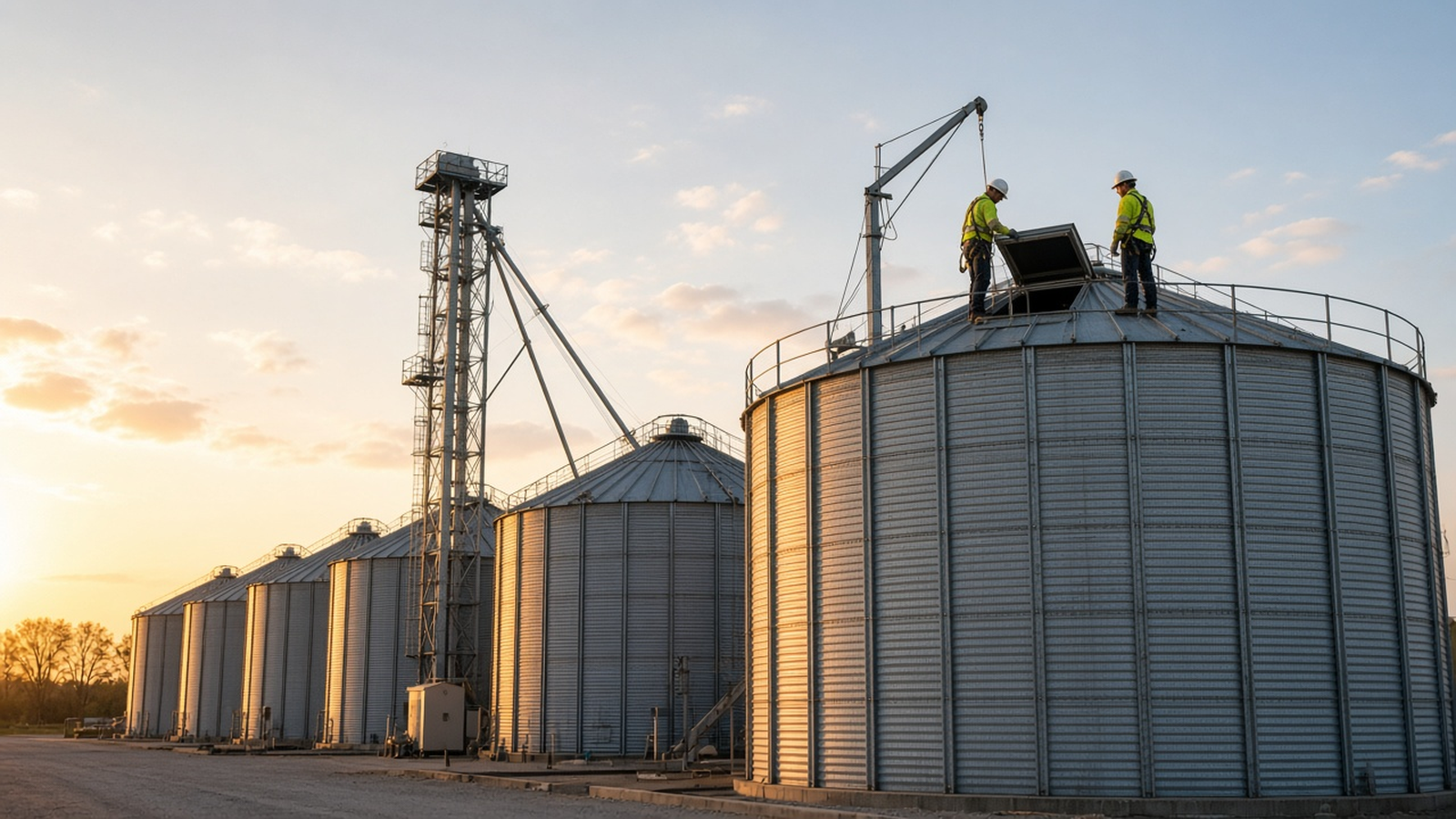
Refinery turnarounds and chemical plants: many entries at once, multiple contractors, night shifts, inerted vessels
Utilities and water/wastewater: vaults, lift stations, and digesters where hydrogen sulfide and methane build up. A review of OSHA-investigated deaths found the highest asphyxiation and poisoning rates in oil and gas and in utilities (Br J Ind Med, 1989).
Grain bins and silos: Purdue documented at least 34 grain entrapments in 2024, and 22 of that year's 51 agricultural confined space cases were fatal (Purdue).

Training Topics Worth Scheduling Before Your Next Outage
Entrant, attendant, and entry supervisor training with signed certification of training (1910.146(g))
Atmospheric testing in the right order: oxygen, then combustibles, then toxics (1910.146(d)(5)(iii))
Retrieval system setup: tripod, winch, harness attachment points, and 5-foot vertical entries
Annual rescue drills in spaces that match your real portal size, access, and obstructions
Respiratory protection: SCBA vs. supplied air, and the IDLH standby requirement in 1910.134
Fall protection for rescuers. See our post on California's fall protection changes.
SSM offers more than 1,700 online and in-person courses. See our employee training and course catalog.
How SSM Can Help
Safety Services Management provides confined space standby rescue services nationwide for refineries, chemical plants, utilities, construction, and industrial sites. We help with scope, entry plans, JHAs, and permits, and you have one point of contact. If another crew is a better fit for your location or schedule, we'll put you in touch with a vetted partner.
Call (714) 455-9832 or email services@safetyservicesmanagement.com
Plan the rescue before the entry.
FAQ
Does OSHA require standby rescue for every confined space entry?
No. The rescue service has to reach the entrant in a time frame that fits the hazards. For IDLH spaces, or spaces that can quickly become IDLH, OSHA's Appendix F says rescue should be standing by at the space. In California, §5157(k) calls for a trained standby person at the site who is immediately available.
Can the attendant do the rescue?
Only non-entry rescue, unless the program allows attendant entry, the attendant is trained and equipped as a rescuer, and another attendant has taken over first.
How often do rescue teams have to practice?
At least once every 12 months, in the actual space or a representative one (1910.146(k)(2)(iv); 1926.1211(b)(4); §5157(k)(1)(C)).
Do you cover sites outside California?
Yes. We coordinate standby rescue nationwide and work in CA, AZ, NV, OR, WA, KY, TN, IL, LA, NJ, FL, TX, and Ontario, Canada.
This post is general information, not legal advice. Check the current OSHA, Cal/OSHA, or state-plan rules that apply to your site.
Sources
NFPA 1006 Standard Development: https://www.nfpa.org/codes-and-standards/nfpa-1006-standard-development/1006
NFPA 2500 Standard Development: https://www.nfpa.org/codes-and-standards/nfpa-2500-standard-development/2500
NFPA 2500 First Revisions (A2026 cycle): https://docinfofiles.nfpa.org/files/AboutTheCodes/2500/2500_A2026_TEC_AAA_FD_FRStatements.pdf
OSHA Emergency Response rulemaking: https://www.osha.gov/emergency-response/rulemaking and Reginfo.gov RIN 1218-AC91: https://www.reginfo.gov/public/do/eAgendaViewRule?RIN=1218-AC91&pubId=202510
OSHA 29 CFR 1910.146: https://www.osha.gov/laws-regs/regulations/standardnumber/1910/1910.146
OSHA 1910.146 Appendix F: https://www.osha.gov/laws-regs/regulations/standardnumber/1910/1910.146AppF
OSHA 29 CFR 1926.1211: https://www.osha.gov/laws-regs/regulations/standardnumber/1926/1926.1211
Cal/OSHA Title 8 §5157: https://www.dir.ca.gov/title8/5157.html and §1960: https://dir.ca.gov/title8/1960.html
Cal/OSHA news release 2022-42 (Valero Benicia): https://www.dir.ca.gov/DIRNews/2022/2022-42.html
BLS, Fatal occupational injuries involving confined spaces: https://www.bls.gov/iif/factsheets/fatal-occupational-injuries-confined-spaces-2011-19.htm
NIOSH 86-110: https://www.cdc.gov/niosh/docs/86-110/ and NIOSH, Deadly rescue: https://stacks.cdc.gov/view/cdc/204435
Deaths from asphyxiation and poisoning at work in the United States 1984-6, Br J Ind Med 1989: https://doi.org/10.1136/oem.46.8.541
Purdue University, 2024 Summary of U.S. Agricultural Confined Space-related Injuries and Fatalities: https://www.purdue.edu/engineering/abe/agconfinespaces/wp-content/uploads/2025/05/2024-Summary-of-U.S.-Agricultural-Confined-Space-related-Injuries-and-Fatalities-Report.pdf
